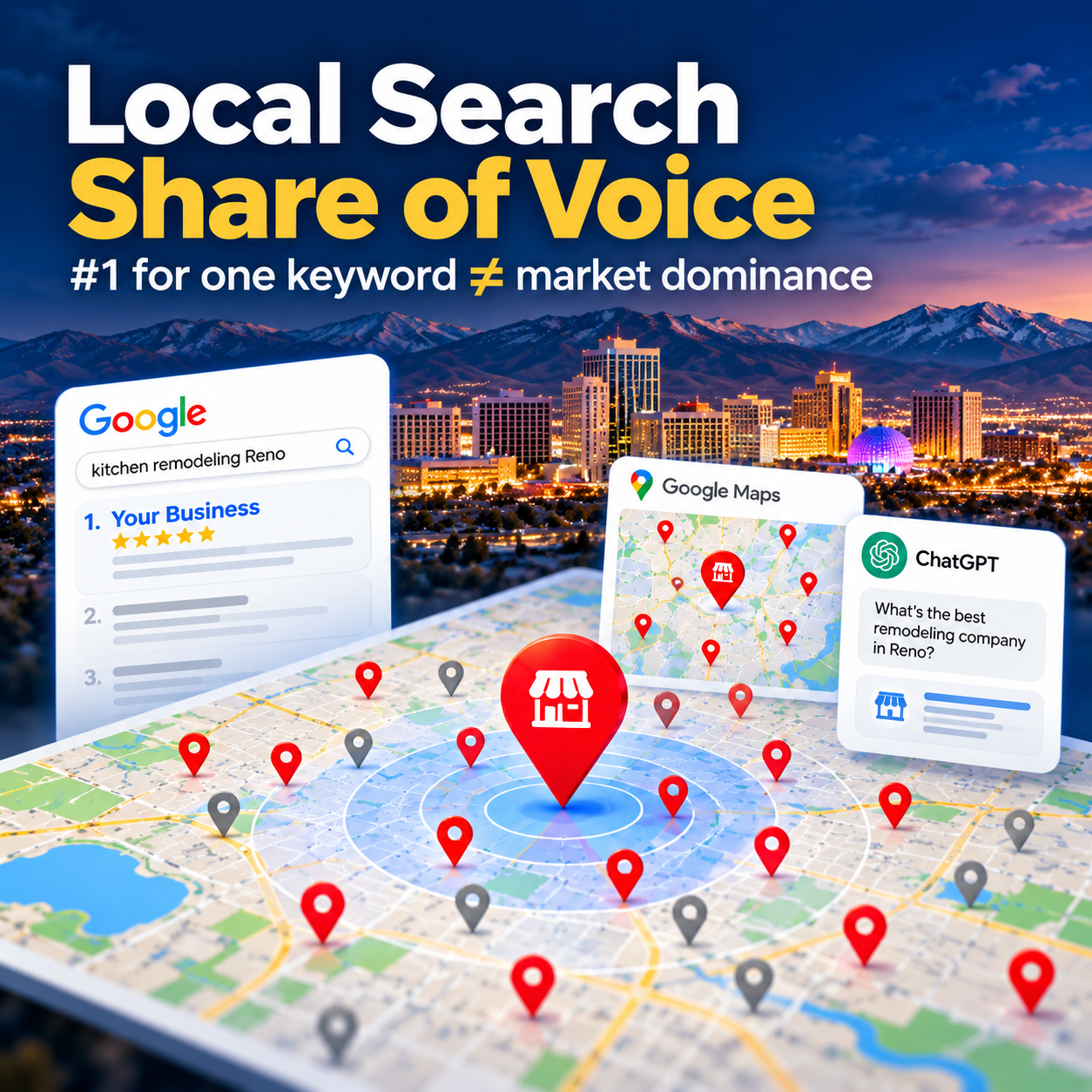
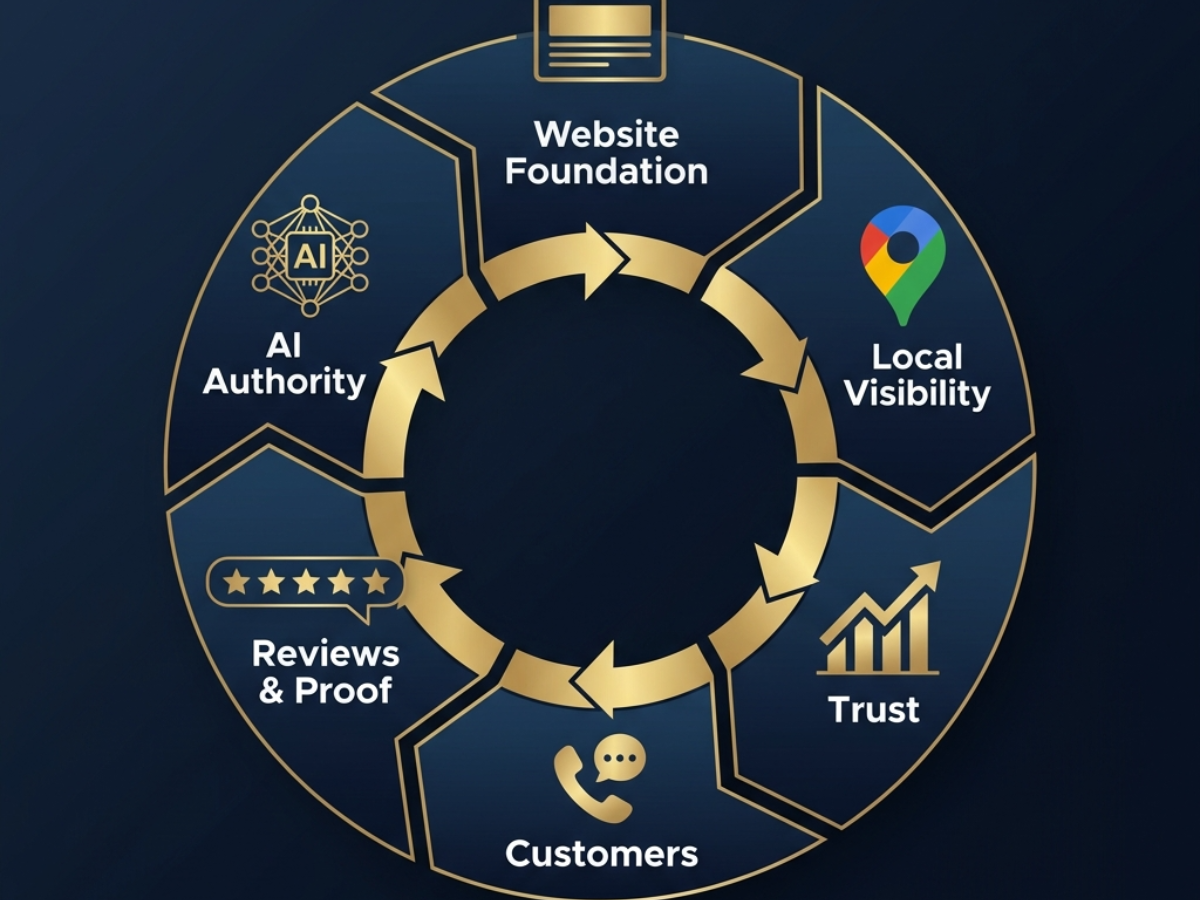
Google's AI-powered search has fundamentally changed how local businesses appear in search results. In 2026, ranking factors now include entity recognition, topical authority, experience signals, and structured content that AI systems can parse and cite. Local businesses that ignore these shifts risk disappearing from both traditional results and AI-generated answers.
Google didn't just add AI to search; it rebuilt how search works from the ground up. For years, local businesses competed for rankings by targeting keywords and collecting backlinks. That playbook still matters, but it's no longer enough. Google's AI systems now evaluate content, credibility, and context in ways that older SEO strategies simply don't address.
The result? Many well-established local businesses are losing visibility to newer competitors who've built AI-friendly websites, even when those competitors have fewer reviews and less history. If your business has noticed a drop in organic traffic, reduced calls from search, or a near-total absence from Google AI Overviews, there's a reason for it and a clear path forward.
This guide breaks down what actually changed, which Google AI ranking factors matter most in 2026, and exactly what local businesses can do to get ahead of this shift.
What Changed After Google Integrated AI Into Search?
Google's integration of AI into its core search product, primarily through AI Overviews (formerly Search Generative Experience) and the Gemini AI model, transformed how search results are generated. Rather than simply matching keywords to pages, Google now attempts to understand meaning, context, relationships between topics, and the trustworthiness of sources.
For local businesses, this created three major shifts:
1. Zero-click results expanded. AI Overviews now answer many queries directly at the top of the page, pulling information from trusted sources without requiring the user to click. If your business isn't cited in those answers, your visibility shrinks significantly.
2. Keyword relevance alone no longer determines rankings. Google's AI evaluates whether a source demonstrates genuine expertise on a topic, not just whether it contains the right words. Thin content, even when keyword-optimized, ranks lower than it used to.
3. Trust signals became critical ranking inputs. Structured data, verified business information, consistent entity data across the web, and third-party citations now carry more weight than before. Google's AI uses these signals to determine which businesses are credible enough to recommend.
How Does Google's AI Evaluate Local Business Websites?
Google's AI evaluates websites through several overlapping lenses. Understanding each one helps local businesses prioritize where to invest their optimization efforts.
Does content quality and depth still influence Google AI rankings?
Yes, and more than ever. Google's AI systems, trained on vast amounts of text, are remarkably good at distinguishing comprehensive content from surface-level filler. A page that genuinely addresses a user's question in depth, covering context, nuance, and related subtopics, scores higher on content quality signals than a page stuffed with keywords.
For local businesses, this means service pages need to go beyond a brief description. They should answer common questions, explain your process, address potential objections, and connect your services to the local context. A plumbing company in Reno, for example, benefits from a service page that addresses local water quality issues, common pipe problems in the region's climate, and what customers should expect during a service visit.
How do structured data and schema markup affect AI search visibility?
Structured data code added to your website that explicitly labels content for search engines gives Google's AI a clearer picture of what your business is, what it offers, and how to categorize it. In 2026, schema markup is a core AI SEO signal, not an optional enhancement.
Critical schema types for local businesses include:
- LocalBusiness schema (including name, address, phone, hours, and service area)
- Review schema (to surface star ratings in search results)
- FAQ schema (to capture featured snippet and AI Overview placement)
- Service schema (to clearly define individual service offerings)
Businesses that implement structured data correctly give Google's AI the structured inputs it needs to confidently recommend them in AI-generated results.
What Experience Signals Does Google's AI Recognize in 2026?
Google's E-E-A-T framework, Experience, Expertise, Authoritativeness, and Trustworthiness, predates AI Overviews, but AI has made it far more actionable. Google's AI now looks for on-page evidence of real-world experience, not just claimed credentials.
Experience signals that Google's AI recognizes include:
- Author bios that reference specific qualifications, years in the field, or professional certifications
- Case studies and project portfolios that demonstrate hands-on results
- Customer reviews embedded or linked on relevant pages
- Before-and-after content or documented project outcomes
- Location-specific detail that proves genuine local presence and knowledge
A landscaping company that publishes detailed project write-ups, describing the soil type, local climate challenges, plant species used, and customer outcomes, sends much stronger experience signals than a company with a generic "We've been serving Reno for 20 years" tagline.
What Are Entity Relationships and Why Do They Affect Local SEO Rankings?
Entity SEO is one of the most underappreciated concepts in local search optimization. Google's AI doesn't just index pages; it builds a knowledge graph of entities (people, places, businesses, concepts) and maps the relationships between them.
For a local business, your entity includes your business name, physical location, services, industry, employees, and the topics you're associated with. The stronger and more consistent those entity signals across the web, the more confidently Google's AI can identify and recommend your business.
How can local businesses strengthen their entity signals for Google AI?
- Keep NAP data consistent (Name, Address, Phone number) across your website, Google Business Profile, Yelp, industry directories, and social media profiles. Inconsistency confuses AI systems and weakens your entity recognition.
- Build topical authority by publishing content that covers your core service area comprehensively. A single page about "HVAC repair" is weaker than a content cluster covering maintenance, common failures, seasonal tips, and local regulations.
- Earn mentions from trusted local sources. Citations in local news sites, industry associations, and regional directories reinforce your entity's legitimacy in Google's knowledge graph.
- Use your business name naturally and consistently across all content. Avoid interchanging brand names with generic descriptors in ways that create ambiguity.
Why Are Local Businesses Disappearing From AI Search Results?
The disappearance of local businesses from AI-generated results typically comes down to four root causes:
1. Unverified or inconsistent business information. Google's AI defaults to recommending sources it can verify. Businesses with outdated Google Business Profiles, mismatched addresses across directories, or missing contact information are deprioritized.
2. Thin or unstructured website content. AI Overviews pull answers from content that is clearly organized, well-structured, and factually precise. Pages without headers, FAQs, or structured data rarely make the cut.
3. Low authority and few external references. Google's AI evaluates how frequently and positively a business is mentioned elsewhere on the web. Businesses with minimal third-party references, reviews, press coverage, or directory listings appear less trustworthy to AI systems.
4. Misalignment with search intent. Even great content fails if it doesn't match the intent behind the query. A user searching "emergency plumber near me" is looking for immediate availability and contact information, not a history of your company. Content must map directly to the intent behind the queries you want to rank for.
How Do You Build an AI-Ready Website for Local Search in 2026?
An AI-ready website communicates clearly, loads fast, and makes it easy for both users and AI systems to understand what your business does and why it's trustworthy. Here's what that looks like in practice:
What website structure works best for Google AI Overviews?
- Answer questions directly and early. Structure pages so that the most important answer appears in the first paragraph, before context or background. AI systems favor content that front-loads clear answers.
- Use descriptive, specific headings. Headings like "What are the Google AI ranking factors for local businesses?" perform better in AI search than vague headings like "Our Approach."
- Create dedicated FAQ sections. FAQ content written in natural, conversational language is consistently pulled into AI Overviews and featured snippets. Every core service page should include a targeted FAQ section.
- Optimize for page speed and mobile usability. Google's AI systems favor pages that deliver a fast, frictionless user experience. Core Web Vitals remain a meaningful ranking input.
- Keep your Google Business Profile complete and active. Regular updates, accurate service categories, high-quality photos, and consistent review responses all contribute to your local AI search presence.
Your AI Search Optimization Checklist for 2026
Use this checklist to audit your local business's AI search readiness:
- ☐ Google Business Profile is complete, verified, and updated within the last 30 days
- ☐ NAP data is consistent across all online directories and your website
- ☐ LocalBusiness, FAQ, and Service schema markup are implemented correctly
- ☐ Core service pages include direct answers to common questions
- ☐ Website content demonstrates genuine expertise and local knowledge
- ☐ Author bios or about pages reference real credentials and experience
- ☐ Each service page includes an FAQ section with conversational questions
- ☐ Content is organized in topic clusters, not isolated keyword pages
- ☐ Business is listed in relevant local and industry directories
- ☐ Core Web Vitals meet Google's recommended thresholds
- ☐ Review generation strategy is active, and responses are consistent
Stop Optimizing for the Old Search: Start Building for AI
The rules of local SEO have been permanently rewritten. Businesses that continue to optimize exclusively for keyword rankings and link counts are chasing a model that search engines have moved beyond. Google's AI ranking factors now reward clarity, depth, consistency, and verified trust, signals that take deliberate effort to build but compound significantly over time.
The businesses winning local AI search in 2026 aren't necessarily the biggest or oldest. They're the ones who have made their expertise legible to machines and their value obvious to humans. Start with your Google Business Profile, audit your schema markup, and build out content that answers real questions with real depth.
If you're not sure where to begin,
Relentless Business Mastery
offers a free marketing strategy session to help local businesses identify exactly where their AI search visibility is falling short and what to do about it.
Book your free session today.