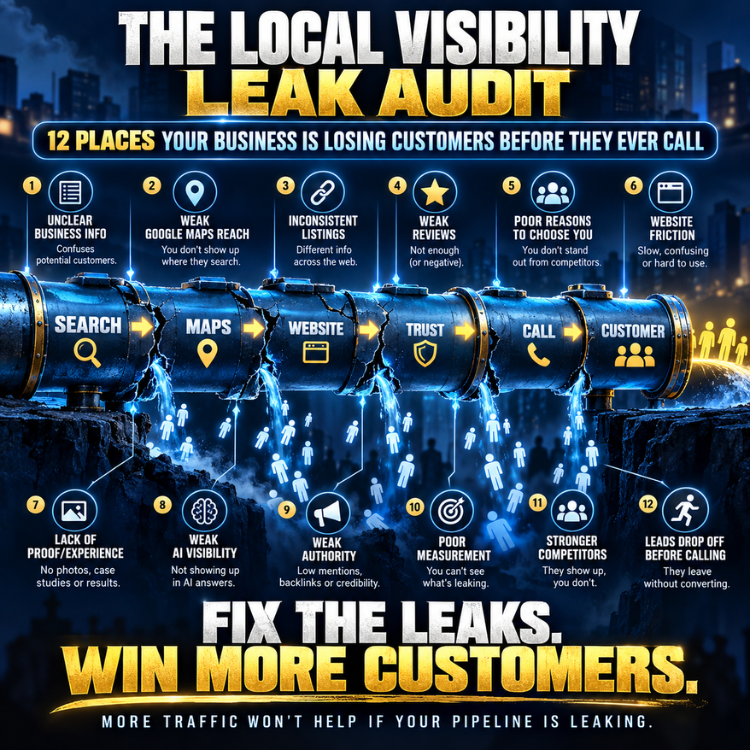
Quick answer: Local search share of voice measures how often and how prominently a business shows up across every search that matters in its market not just one keyword. It covers keyword coverage, geographic reach, service visibility, and presence across Google Maps, organic search, and AI tools. A business can rank #1 for one term and still be invisible for 80% of the searches its customers actually run.
A Reno contractor recently told us something that sounded like good news: "We're #1 on Google for 'kitchen remodeling Reno.'" It is good news. It's also incomplete news.
When we pulled a broader visibility report, that same business was nowhere to be found for "bathroom remodeling," ranked 11th for searches coming from the other side of town, and didn't show up at all when we asked ChatGPT for a remodeling recommendation in Reno. One ranking looked great. The business's actual footprint in the market told a different story.
This is the gap most ranking reports never show you. They answer a narrow question "Where do I rank for this keyword?" when the question that actually determines whether your phone rings is much bigger: how much of your market can find you at all?
That's what local search share of voice measures. It's the difference between a single data point and the full competitive picture. If you've ever looked at a glowing ranking report and wondered why leads still feel inconsistent, this is probably why.
Why Traditional Ranking Reports Can Be Misleading
Most ranking reports check one keyword from one location and call it a day. The problem is that your customers aren't searching from one location, and they're not all using the same words.
Local rank is a different number for every place a person could be standing when they search. Proximity between the searcher and your business is one of the factors Google weighs, so your position naturally decays with distance from your address. A report that only checks from your office address will almost always show your best possible ranking which is exactly the number that tells you the least about how customers across your actual service area experience your visibility.
Here's where this becomes genuinely costly: averages hide decline. A single position on a report almost never goes down, which is what makes that kind of reporting comfortable and nearly useless at the same time. You can be slowly losing ground in half your service area while the number on your monthly report stays flat, because the one spot being measured happens to be the one spot where you're still strong.
Ranking #1 for a single keyword from a single location isn't a market position. It's a snapshot and snapshots can be flattering without being true.
What Is Local Search Share of Voice?
Local search share of voice is a broader way to measure visibility. Instead of tracking one keyword, it tracks how consistently your business shows up across the full range of searches, locations, and platforms where your customers are actually looking.
Four components make up that picture:
- Keyword coverage — how many of the searches your buyers actually run can find you
- Geographic coverage — where your visibility holds up, and where it falls apart
- Service coverage — whether you show up for everything you sell, not just your flagship offering
- Platform coverage — how you perform across Google Maps, organic search, and AI-generated answers
Put those four together and you get something closer to a market share number than a ranking number. You stop asking "Am I #1?" and start asking "How much of my addressable market can actually see me?" That second question is the one that correlates with calls, bookings, and revenue.
Keyword Coverage: How Many Buying Searches Can Actually Find You?
Most local businesses rank well for the keyword they've always optimized for and remain invisible for everything else their customers type into Google.
A flooring dealer might dominate "flooring store near me" while missing entirely on "hardwood flooring installation," "carpet replacement cost," or "vinyl plank flooring near me" searches with just as much buying intent, sometimes more. If those secondary terms represent even a third of your category's search volume, that's a third of your market effectively going to whoever does show up.
Keyword coverage asks a simple question: out of every search a potential customer might run to find a business like yours, how many of them actually surface your name? If the honest answer is "a handful," your single #1 ranking is covering a lot less ground than it feels like it is.
Geographic Coverage: Where Does Your Visibility Start and Stop?
This is where geo-grid tracking becomes useful, and where most businesses are flying blind.
A geo-grid tool samples a spread of coordinates across your service area and checks your ranking from each point independently, rather than checking once from your business address.
The result isn't one number it's a map. And that map rarely looks like a neat circle around your location. Coverage bulges toward the neighborhoods where you have reviews and backlinks, and collapses in areas where a stronger competitor has built up presence.
Reporting by city or by zip code hides this shape. A citywide average might show you looking stable while your ranking inside it swings by fifteen positions from one side of town to the other. The useful rule here: a grid tells you specifically where you're losing. A single average only tells you whether you're losing, and even then, not reliably.
The number worth tracking isn't your best position or your average position it's the share of sampled points across your service area where you land in the top three. That's the figure that moves when something is actually changing, instead of sitting still while your real visibility erodes underneath it.
Service Coverage: Are You Visible for Everything You Actually Sell?
Keyword and geographic coverage both assume customers are searching for the right service to begin with. Service coverage asks whether your business shows up for the full range of what you offer not just your highest-volume category.
A medical practice might rank well for its primary specialty and be completely absent from searches for a secondary service line that represents real revenue. A contractor might own "roof repair" and disappear for "roof inspection" or "storm damage roofing." Each gap is a category of customer actively looking for exactly what you do, finding a competitor instead.
This matters because service coverage gaps are often the easiest to fix and the ones businesses are least likely to notice, because nobody's watching for the absence of something.
Google Maps vs. Organic vs. AI Visibility
Different result sets, different rules and a business can be strong in one while being effectively absent in another.
Keyword and service-line coverage beyond your top-performing term
AI Search (ChatGPT, Gemini, Copilot)
Whether your business gets named when AI tools are asked for a recommendation
Autocomplete
Whether your brand or services surface as suggestions before a search is finished
"Near Me" Searches
Local-intent visibility, where the top three results on the Map Pack capture the majority of clicks
Traditional search still represents roughly 75% of total search volume, and the map pack makes up about 40% of that, which is exactly why
Google Maps visibility can't be an afterthought. But AI search is no longer a side conversation either. Unlike a traditional results page, AI tools typically offer one to five recommendations with no scrolling and no ads. If your business isn't one of those recommendations, you're not ranked low; you're not there at all.
A business that only measures organic rank is tracking one surface out of several that determine whether a customer finds them.
Competitive Coverage: Where Are Competitors Beating You?
Share of voice only means something in context. Knowing you show up for 40% of relevant searches is useful. Knowing a competitor shows up for 75% of those same searches is what tells you whether 40% is a win or a warning sign.
Competitive coverage maps your visibility against the businesses actually competing for the same customers keyword by keyword, neighborhood by neighborhood, platform by platform. This is usually where the real story shows up. A business can be comfortably ahead on its flagship keyword and quietly losing ground everywhere else, because the competitor investing in broader coverage is picking up customers the ranking report never accounts for.
Why One #1 Ranking Can Create False Confidence
A single top ranking feels like proof that your marketing is working. Sometimes it is. But a #1 position on one keyword, checked from one location, is compatible with a wide range of underlying realities including one where your overall visibility is shrinking.
This is the trap: the keyword you've always tracked is usually the one you've invested in longest, which makes it the one most likely to still look strong even while everything around it erodes.
Meanwhile, AI search adoption is accelerating some industry forecasts suggest roughly a quarter of search activity could shift to AI engines by 2026 and a ranking report that only checks traditional organic results has nothing to say about whether you're showing up there at all.
One ranking is a data point. It was never meant to be a market report.
How to Calculate Your Local Visibility Footprint
Building an honest picture of your market visibility takes a handful of specific checks:
- Run a geo-grid scan across your full service area not just from your business address and record the share of points where you land in the top three.
- List every keyword a real customer would use, including service-specific and problem-based searches, not just your primary category term.
- Check your visibility across Maps, organic, and AI search separately. Strength in one doesn't carry over to the others.
- Run the same checks for your top two or three competitors so your numbers have context.
- Repeat on a consistent schedule. Local rankings shift week to week for reasons that have nothing to do with you the goal is tracking direction over months, not reacting to noise.
What comes out of that process isn't a ranking. It's a footprint a realistic picture of how much of your market can actually find you, and where the gaps are costing you customers.
From Ranking Reports to Market Intelligence
A ranking tells you where you stand on one search. Market intelligence tells you where you stand in your market. Those are different questions, and only one of them explains why the phone is or isn't ringing.
Businesses that shift from tracking a single keyword to tracking their full local search share of voice usually find the same thing: there's more opportunity sitting in the gaps than there is in defending the one ranking they already have. A competitor isn't beating you because they're better. They're often just covering more ground.
How much of your market can actually find you?
Request a FREE
Local Search Visibility Evaluation from
Relentless Business Mastery and get a clear picture of your keyword coverage, geographic reach, and AI search visibility benchmarked against the competitors actually taking your customers.