Entity SEO: How Google Learns to Trust Your Business
Quick answer: Entity SEO is the practice of helping search engines understand who your business is, what it does, and how it connects to other trusted people, organizations, locations, and topics. When Google can clearly identify your business as a trusted entity, it is more likely to recommend it in both traditional search results and AI-generated answers.
Most business owners think SEO is about keywords. Pick the right ones, sprinkle them across your website, and Google will send you customers. That logic made sense in 2010. It does not reflect how Google actually works today.
Google has evolved. It no longer just matches words on a page to words in a search query. It attempts to understand meaning, people, places, organizations, concepts, and the relationships between them. This shift is what makes Entity SEO one of the most important and least understood strategies in modern search marketing.
For local businesses trying to compete online, understanding entity SEO is not optional. It is the foundation upon which Google Maps rankings, AI-generated recommendations, and organic search visibility are increasingly built. If Google does not clearly understand who your business is, your chances of being recommended by traditional search or AI tools like ChatGPT, Gemini, or Google AI Overviews are significantly reduced.
This guide explains what entity SEO is, how it works, and what your business needs to do to build the kind of trust that drives real visibility and real customer inquiries.
What Is an Entity in SEO Terms?
An entity is anything that Google can uniquely identify and distinguish from everything else. A person, a business, a location, a brand, a product, a concept; each of these can be an entity.
What makes entities different from keywords is specificity. A keyword is a string of text. An entity has an identity. Google's systems can recognize that "Apple" the technology company and "apple" the fruit are two entirely different entities, even though the word is identical.
For a local business, the goal is to become a clearly defined entity in Google's understanding of the world. That means Google should be able to answer these questions confidently:
- What is this business?
- What does it do?
- Where is it located?
- Who does it serve?
- How does it relate to other trusted entities in its industry and market?
When Google can answer those questions with confidence, it begins to treat your business as a credible, trustworthy entity; one worth surfacing to customers who are actively searching for what you sell.
Keywords vs. Entities: What's the Real Difference?
Traditional keyword SEO asks: "What words are people searching for?"
Entity SEO asks: "Does Google understand what my business actually is?"
These are very different questions. A business could rank for a keyword without Google truly understanding what that business does. Conversely, a business that Google deeply understands as a trusted entity can earn visibility across a much wider range of relevant searches, including searches it never specifically optimized for.
Think of it this way. Keywords are inputs. Entities are identities. The businesses that build strong entity identities stop chasing individual keywords and start capturing broader categories of search intent. That is a significant competitive advantage.
How Google's Knowledge Graph Connects Everything
Google's Knowledge Graph is the massive database of entities and relationships that powers modern search. Launched in 2012, the Knowledge Graph allows Google to understand not just what words mean, but who and what they refer to, and how they connect to each other.
When a business has a strong presence in the Knowledge Graph, Google can:
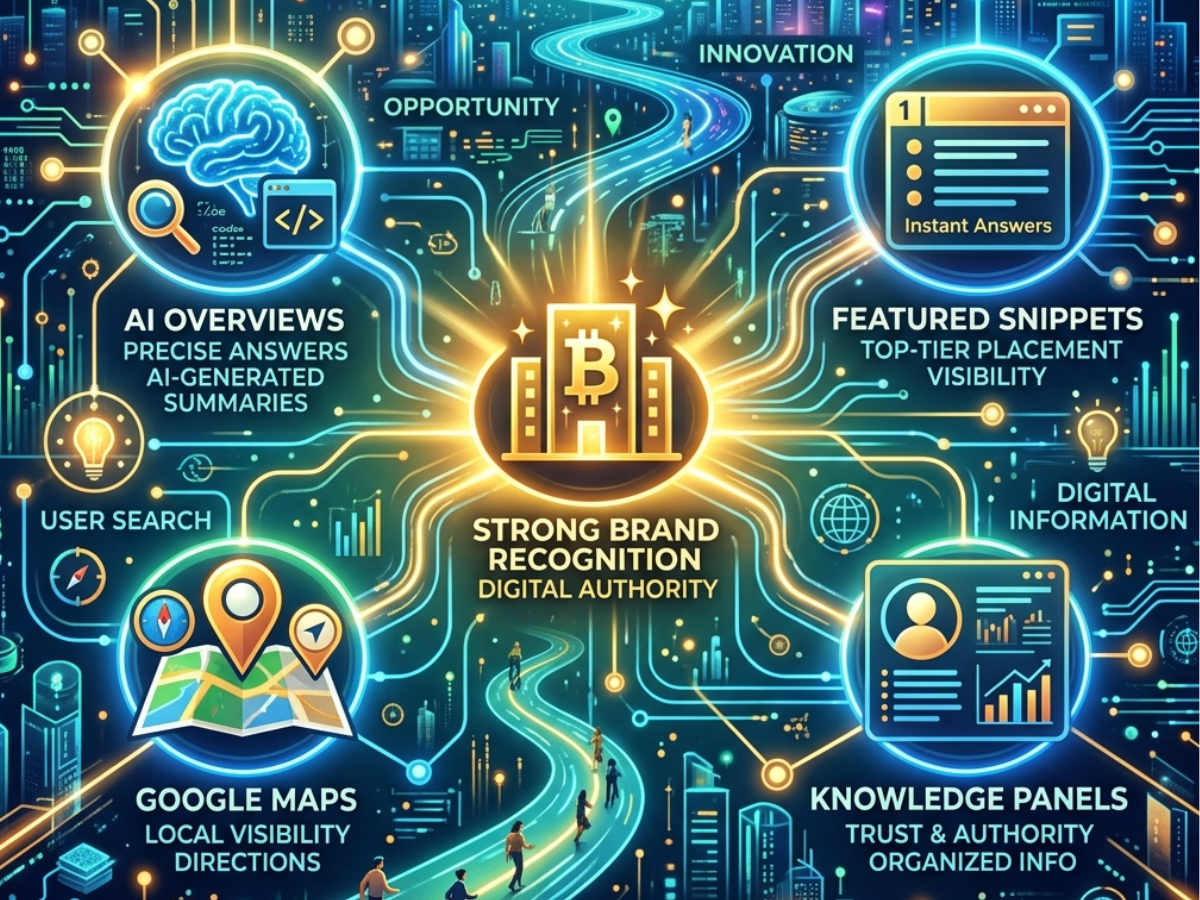
- Display a Knowledge Panel with accurate business information
- Recommend the business in voice search results
- Feature the business in AI-generated answers
- Connect the business to relevant topics, locations, and industry categories
A Knowledge Graph entry is not something you manually create. Google builds it from signals across the web, your website, your Google Business Profile, your business listings, mentions from third-party sources, structured data markup, and more. The stronger and more consistent these signals, the more confident Google becomes in recognizing and trusting your business as an entity.
Why Building Entity Relationships Matters for Local Businesses
Google does not evaluate entities in isolation. It evaluates them within a network of relationships. A business gains credibility not just from what it says about itself, but from what other trusted entities say about it.
This is where topical authority and brand entity strength come into play. If your business is consistently mentioned alongside other trusted businesses, industry organizations, local landmarks, or authoritative publications, Google begins to associate your brand with credibility in a specific space.
For local businesses, this has direct implications for Google Maps rankings and local search visibility. A plumbing company mentioned in a local news article, listed accurately across major business directories, and discussed in community forums carries far more entity weight than a plumbing company with only a website and a Google Business Profile.
The practical takeaway: entity SEO is not a single tactic. It is a cumulative strategy.
How to Use Structured Data to Signal Your Entity to Google
Structured data, also called schema markup, is code added to your website that explicitly tells search engines what your business is, what it does, and how to categorize it. It speaks directly to Google's entity-recognition systems.
For local businesses, the most important schema types include:
- LocalBusiness schema — Confirms your business name, address, phone number, category, and service area
- Organization schema — Establishes your brand identity, logo, and social profiles
- Service schema — Describes individual services you offer
- Review schema — Surfaces star ratings in search results
Structured data does not guarantee rankings. What it does is reduce ambiguity. When Google can read explicit entity signals from your website, it no longer has to guess what your business is. That clarity translates into stronger entity recognition, and stronger entity recognition translates into better visibility.
If your website does not currently use structured data, this is one of the highest-leverage technical improvements a local business can make.
Why Mentions Across the Web Are Essential to Entity SEO
Structured data tells Google what you claim your business to be. Third-party mentions tell Google what others recognize your business as. Both matter, but independent mentions from authoritative sources carry significant weight.
These mentions, often called citations in local SEO, or co-citations in entity SEO, include:
- Business directory listings (Google Business Profile, Yelp, BBB, Apple Maps, industry directories)
- Local news coverage and press mentions
- Industry association memberships
- Customer reviews on third-party platforms
- Social media profiles linked to your business
- Partner websites and professional organization pages
The key is consistency. Every mention of your business name, address, and phone number across the web should be accurate and uniform. Inconsistencies confuse Google's entity-recognition systems and reduce confidence in your business identity. Consistent, accurate mentions reinforce it.
For businesses operating in competitive local markets, business listings management is not a one-time task. It is an ongoing strategy that directly supports entity strength and local search visibility.
How AI Uses Entities to Generate Search Recommendations
This is where entity SEO connects directly to the future of search.
AI-powered search tools- Google AI Overviews, ChatGPT, Gemini, Perplexity- do not retrieve web pages the way traditional search engines do. They generate answers based on their understanding of entities, relationships, and context. When someone asks an AI tool for a recommendation, it names businesses it has enough structured, trustworthy information about to recommend with confidence.
This is a fundamental shift. In traditional SEO, you competed for a position on a search results page. In AI search, you are competing to be understood well enough to be recommended at all. Businesses that Google and AI systems do not clearly recognize as entities will not appear in these recommendations, regardless of how well their website is written.
Entity SEO is, therefore, one of the most direct ways to prepare your business for AI search visibility. A strong entity presence gives AI systems the signals they need to confidently name your business when it is relevant to a customer's query.
At Relentless Business Mastery, this intersection of entity SEO, local search, and AI SEO is exactly where we focus our clients' digital marketing strategies.
How Strong Entity SEO Connects to Business Listings and Local SEO
Entity SEO and local SEO are not separate strategies. They are deeply interconnected.
Your business listings across major directories are direct entity signals. Your Google Business Profile is one of the most powerful entity signals available to a local business. Your website's structured data, your reviews, your social profiles, and your local citations all contribute to the overall strength of your entity presence.
When all of these signals are consistent, optimized, and pointing in the same direction, Google builds a stronger, more confident understanding of your business. That confidence is what earns higher Google Maps rankings, stronger organic visibility, and a greater likelihood of being included in AI-generated local recommendations.
Local SEO is not just about appearing in the Map Pack. It is about making your business recognizable, trustworthy, and recommendable across every surface where potential customers are searching—traditional search, voice search, and AI-powered tools.
How to Appear in Featured Snippets Using Entity SEO
Google's featured snippets, the answer boxes that appear above organic results, are another area where entity authority plays a direct role.
When Google trusts your business or website as a credible entity within a topic, it is more likely to pull your content into featured snippets for relevant questions. To improve your chances of capturing featured snippets:
- Answer questions directly and concisely within your content
- Use clear question-based headings that mirror how customers search
- Structure answers so the key information appears within the first two to three sentences
- Build entity authority within your topic area through consistent, expert content and strong external signals
The businesses most likely to appear in featured snippets are the ones Google has already identified as knowledgeable, trustworthy entities within their category. Entity SEO and featured snippet optimization are two sides of the same coin.
Where to Focus Your Entity SEO Efforts Right Now
Entity SEO can feel overwhelming because it touches so many parts of your digital presence. Here is a practical sequence for local businesses ready to build entity strength:
- Audit your business information — Confirm your business name, address, phone number, and category are accurate and consistent everywhere they appear online
- Optimize your Google Business Profile — This is your most important entity signal in local search
- Implement structured data on your website — Start with LocalBusiness and Organization schema
- Build consistent business listings — Prioritize major directories and industry-specific platforms
- Earn third-party mentions — Pursue local press, industry associations, and relevant community platforms
- Create topically authoritative content — Build a content strategy that establishes your expertise within your category
- Connect your AI SEO and search box optimization strategies — Ensure your entity signals are optimized for both traditional and AI-powered search
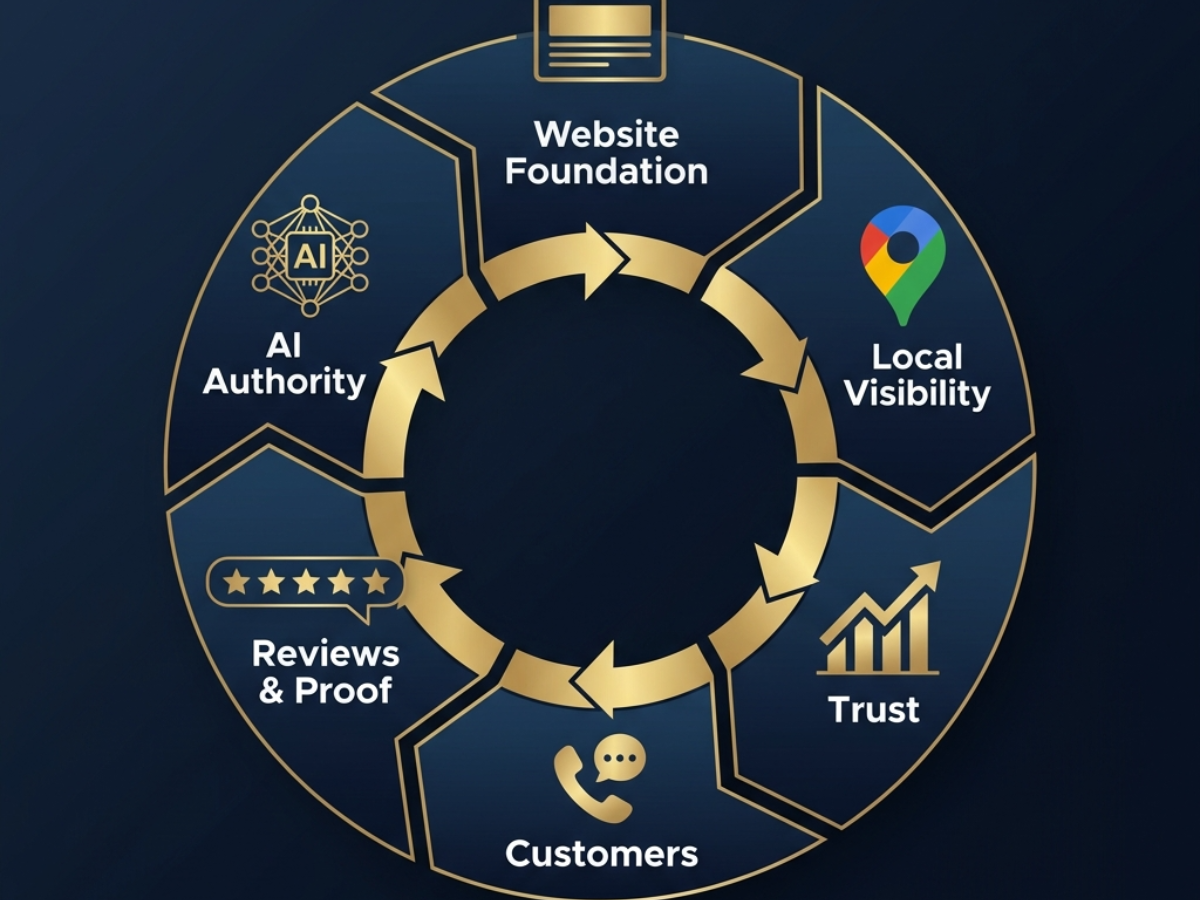
Each of these steps compounds. The more consistently you build entity signals over time, the more confident Google becomes in your business.
Build the Search Visibility That Competitors Can't Easily Erase
Entity SEO is not a quick fix. It is a strategic investment in how search engines—and AI systems—understand and trust your business. Done consistently over time, it produces durable, competitive search visibility that's increasingly difficult for competitors to overtake.
Businesses that invest in entity SEO today are building an asset. Every accurate listing, every structured data implementation, every authoritative mention, and every piece of topically relevant content adds to a foundation that continues to compound in value.
If you are not sure how strong your entity presence currently is, or whether Google clearly understands what your business does and who it serves, that is exactly the kind of gap a free marketing strategy session with Relentless Business Mastery is designed to identify.
Your customers are already searching. The question is whether Google knows enough about your business to send them your way.
Book Your Free Strategy Session
Frequently Asked Questions About Entity SEO
What is Google's Knowledge Graph and why does it matter for my business?
Google's Knowledge Graph is a database of entities—people, places, organizations, and concepts—and the relationships between them. It powers Google's ability to understand meaning rather than just match keywords. When your business has a strong presence in the Knowledge Graph, Google can more confidently surface it in search results, Google Maps, voice search, and AI-generated answers. A Knowledge Graph listing often appears as a Knowledge Panel on the right side of search results, displaying your business name, category, reviews, and contact information.
How does entity SEO improve search rankings for local businesses?
Entity SEO improves rankings by increasing Google's confidence in your business identity. When Google clearly understands what your business is, where it operates, and how it relates to relevant topics and locations, it is more likely to show your business across a wider range of relevant searches. Consistent business listings, structured data, a well-optimized Google Business Profile, and third-party mentions all contribute to this entity confidence—which translates into stronger local search and Google Maps visibility.
Are backlinks still important in an entity-based SEO approach?
Yes, but their role has evolved. In entity SEO, a link from an authoritative, relevant source is valuable not only for passing ranking signals but also for establishing entity associations. A mention or link from a trusted local news outlet, an industry association, or a well-known directory reinforces Google's understanding of what your business is and where it belongs within a category. Quality and relevance matter far more than volume.
How does entity SEO help my business appear in AI-generated search results?
AI search tools like Google AI Overviews, ChatGPT, and Gemini generate recommendations based on how well they understand the entities in their training data. Businesses with strong, consistent entity signals—accurate business information, structured data, authoritative third-party mentions, and clear topical relevance—give AI systems the information they need to confidently recommend them. Entity SEO is one of the most direct strategies for improving visibility in AI-powered search environments.
How is entity SEO different from traditional keyword SEO?
Traditional keyword SEO focuses on optimizing specific pages for specific search terms. Entity SEO focuses on building Google's comprehensive understanding of what your business is. A business with strong entity authority can earn visibility for relevant searches it never specifically optimized for—because Google understands the business well enough to recognize its relevance. Entity SEO is broader, more durable, and increasingly aligned with how both traditional and AI-powered search systems operate.
How long does it take for entity SEO efforts to produce results?
Entity SEO is a cumulative, long-term strategy. Some improvements, like correcting inconsistent business listings or adding structured data, can produce faster results. Building a strong, comprehensive entity presence through third-party mentions, content authority, and consistent signals typically takes three to six months to show measurable impact. The competitive advantage compounds over time, making it a high-value long-term investment.
Have any more questions?
Recent Posts