The Complete Local SEO Ecosystem: How It All Works Together
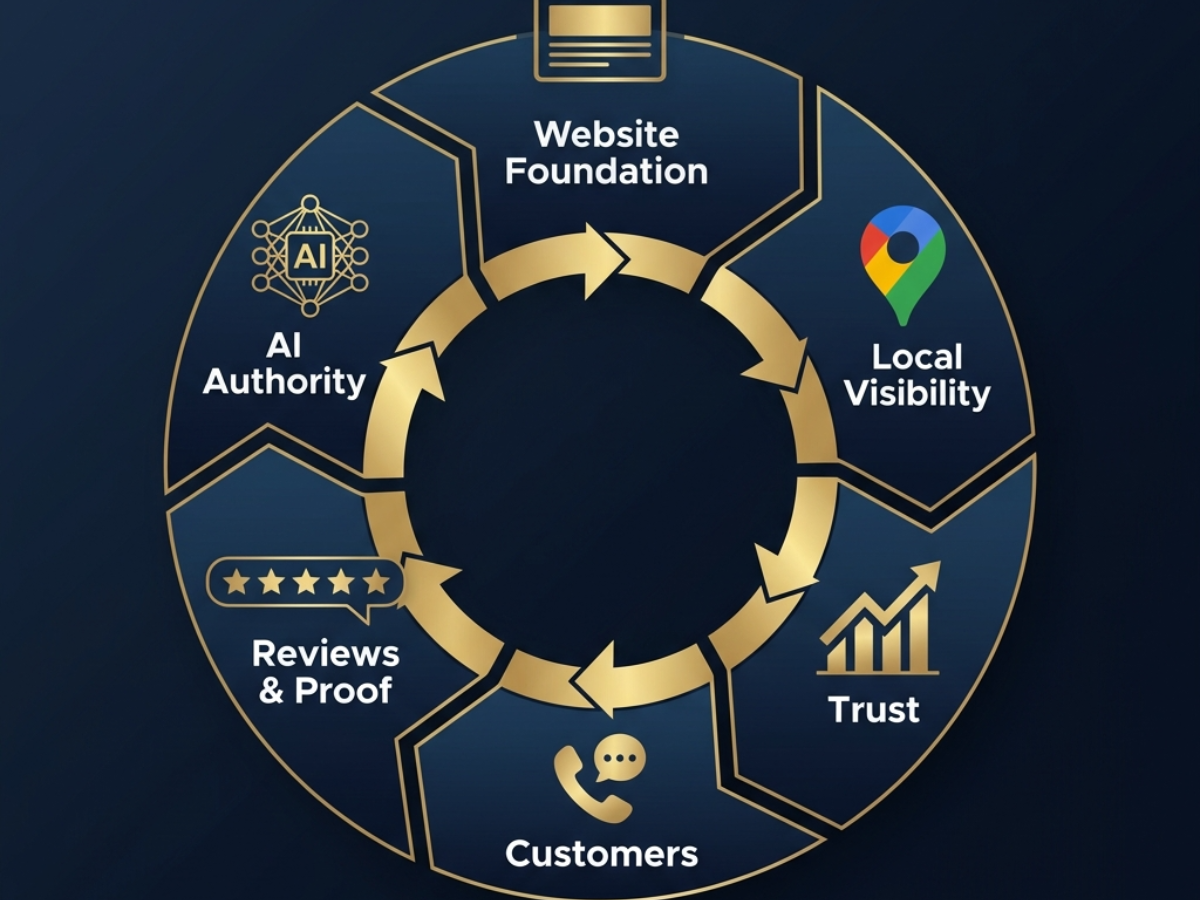
Quick answer: Local SEO is not a single tactic; it's an interconnected system of website optimization, Google Business Profile management, reviews, citations, Maps presence, and AI search visibility. Businesses that treat these as separate efforts miss the compounding effect that comes from optimizing all of them together. This guide explains how each piece connects.
Key Takeaways
- Your website, Google Business Profile, reviews, citations, and Maps listing all feed into one another; weakness in one area limits the rest.
- Google AI Overviews and conversational search engines like ChatGPT now pull from structured, authoritative local content.
- Search Box Optimization (SBO) helps your business appear as an autocomplete suggestion before users even finish typing.
- Reputation management is not optional; it directly influences both local rankings and AI-generated recommendations.
- Consistent measurement ties the entire ecosystem together and shows you what's working.
Most business owners think of local SEO as a checklist. Claim the Google Business Profile. Get some reviews. Build a few links. Done.
But that's not how Google sees it. Google's local ranking system reads your entire digital footprint: your website, your reviews, your citations, your Maps presence, and now your AI search signals, as one interconnected ecosystem. Each element influences the others. Optimize them in isolation, and you'll hit a ceiling. Build them as a unified system, and the results compound.
This guide breaks down each component of a complete local SEO strategy and explains exactly how Google connects them. By the end, you'll know not just what to do, but why it works.
How Does Website Optimization Affect Local Search Rankings?
Your website is the foundation. Everything else in your local SEO ecosystem points back to it, and Google evaluates it constantly to determine whether your business deserves to rank.
For local SEO specifically, your website needs to do several things well:
- Location signals: Include your city, neighborhood, and service areas naturally throughout your content, not crammed into footers, but woven into service pages, blog posts, and FAQs.
- NAP consistency: Your Name, Address, and Phone Number must appear on your website exactly as they do on your Google Business Profile and every directory listing. Even minor inconsistencies ("St." vs. "Street") create trust problems for Google.
- Page speed and mobile experience: Google's Core Web Vitals directly affect local rankings. A slow website that frustrates mobile users sends negative signals to both Google and your potential customers.
- Schema markup: LocalBusiness structured data tells Google (and AI systems) exactly who you are, what you offer, where you're located, and what hours you keep. This is one of the most underused tools in local SEO.
- Landing pages for each service and location: If you serve multiple areas or offer multiple services, dedicated pages for each improve your relevance for those specific searches.
Think of your website as your proof of legitimacy. Google uses it to verify that the information on your Google Business Profile is accurate and that your business genuinely serves the community it claims to.
What Is Google Business Profile and Why Does It Drive Local Visibility?
Your Google Business Profile (GBP) is your direct line to Google's local search results: the Map Pack, the Knowledge Panel, and Google Maps. It's often the first thing a potential customer sees before they ever visit your website.
An optimized GBP includes:
- Complete and accurate business information (category, hours, address, phone, website)
- Regularly updated photos of your team, location, and work
- Google Posts that share promotions, news, and updates (these also help AI systems understand your business activity)
- Products and services listed with detailed descriptions
- Review responses that demonstrate engagement
Google evaluates three primary factors for local rankings: relevance, distance, and prominence. Your GBP directly affects all three. Relevance improves when your profile clearly communicates what you do. Prominence grows as you earn reviews, citations, and links. Distance is fixed, but a stronger profile extends your effective ranking radius.
One important detail many businesses overlook: Google cross-references your GBP data with your website and third-party directories. Inconsistencies lower your trust score. Consistency across every platform signals credibility.
How Do Online Reviews Influence Local SEO and AI Search Results?
Reviews do more than build trust with potential customers. They are an active ranking signal in Google's local algorithm, and they're increasingly shaping what AI systems like Google's AI Overviews recommend.
Google looks at:
- Review volume: How many reviews you have compared to competitors
- Review recency: A business with recent reviews outperforms one with older reviews, even if the older business has more total reviews
- Review sentiment: Positive language in reviews, especially language that matches search queries, boosts relevance
- Response rate: Businesses that consistently respond to reviews signal active management, which Google rewards
For AI search visibility, reviews carry even more weight. When someone asks ChatGPT or Google's AI Overview "Who is the best plumber in Reno?", the AI pulls from structured review data, mentions across the web, and sentiment analysis. A business with strong, recent, well-responded-to reviews gets cited. A business that hasn't invested in reputation management gets ignored.
Proactive reputation management, generating a steady stream of authentic reviews and responding thoughtfully to all of them, is no longer optional. It's a core part of your local SEO strategy.
What Are Local Citations and Why Do They Still Matter?
A citation is any online mention of your business name, address, and phone number. Directories like Yelp, the Better Business Bureau, Apple Maps, Bing Places, and hundreds of niche directories all contribute to your citation profile.
Google uses citations to verify that your business is legitimate and to confirm the accuracy of your GBP information. The more consistent and widespread your citations, the more confident Google becomes in your legitimacy, and the more prominently it ranks you.
Citation building in 2025 is less about volume and more about accuracy and authority. Forty low-quality, inconsistent citations will hurt you more than ten accurate listings on high-authority directories.
Key principles for citation management:
- Audit existing citations to identify and correct inconsistencies
- Prioritize authoritative directories relevant to your industry and location
- Maintain consistency across every listing, exact match for business name, address, and phone
- Claim and optimize niche directories that your competitors may be ignoring
Voice search relies heavily on citations, too. When Siri or Alexa answers "Find a dentist near me," they pull from aggregated directory data. A clean, consistent citation profile ensures your business surfaces in those results.
How Does Google Maps SEO Differ From General Local SEO?
Google Maps and local SEO are deeply connected, but Maps has its own optimization layer that many businesses underestimate.
Ranking in Google Maps requires strong signals in four areas:
- Proximity: How close your business is to the searcher's location at the moment of the search
- Relevance: How closely your GBP and website match the search query
- Prominence: How well-known and trusted your business is online (reviews, citations, links, mentions)
- Behavioral signals: How often users click on your listing, request directions, call directly, or visit your website from Maps
That last point is underappreciated. Google monitors how users interact with your Maps listing. A listing that generates consistent engagement sends positive signals. A listing that gets ignored, even if technically well-optimized, stagnates.
Improving Maps rankings means building a profile compelling enough that users choose to engage. Strong photos, an accurate business description, complete service listings, and active review management all contribute to this.
Geographic ranking tools (sometimes called GEO Rank or grid-rank tracking) allow you to visualize how your business ranks across different locations within your service area. This reveals gaps and guides targeted optimization efforts.
What Are Google AI Overviews and How Do They Affect Local Businesses?
Google AI Overviews represent a fundamental shift in how search results are delivered. Instead of showing a list of links, Google's AI synthesizes information from across the web and presents a direct answer at the top of the page. For local businesses, this creates both a challenge and an opportunity.
The challenge: users may get answers without clicking through to your website. The opportunity: if your business is cited in the AI Overview, you gain credibility and visibility that traditional rankings can't match.
To earn citations in Google AI Overviews, your content and digital presence need to meet a high bar for trust and clarity:
- Structured content with clear headings, FAQs, and defined answers to common questions
- Schema markup that helps Google's AI parse your business information accurately
- High-quality reviews with detailed, specific language
- Consistent entity information across your website, GBP, and third-party sources
- Authoritative content that demonstrates topical expertise in your industry
Generative Engine Optimization (GEO) is the practice of optimizing specifically for these AI-driven results. It combines traditional SEO fundamentals with structured data, entity building, and conversational content strategy. Businesses that invest in GEO now are positioning themselves ahead of the majority of local competitors who haven't yet adapted.
What Is Search Box Optimization and How Does It Capture Ready-to-Buy Customers?
Search Box Optimization (SBO) is a newer local visibility strategy that focuses on getting your business name or service to appear as an autocomplete suggestion in Google's search bar—before the user even finishes typing their query.
When a potential customer types "plumbers in R..." and your business name appears as a suggestion, the click-through behavior changes dramatically. Users who select autocomplete suggestions are already primed to take action. They didn't stumble on your listing, they were guided to it.
SBO works by building consistent, high-volume search behavior around specific branded and service-based queries. It complements your organic rankings, GBP optimization, and paid ads by capturing intent at the earliest possible moment in the search process.
Not every market or keyword supports SBO equally, but for businesses operating in competitive local markets, it represents a powerful edge over competitors still focused exclusively on traditional ranking signals.
Why Is Reputation Management a Core Local SEO Strategy?
Reputation management connects nearly every element of the local SEO ecosystem. Your reviews affect Maps rankings. Your review responses signal engagement to Google. Your online sentiment shapes what AI systems recommend. Your star rating determines whether potential customers click on your listing or skip past it.
A complete reputation management strategy includes:
- Proactive review generation: Asking satisfied customers for reviews at the right moment, through the right channels
- Timely review responses: Responding to every review—positive and negative—within 48 hours
- Monitoring across platforms: Google, Yelp, Facebook, and industry-specific directories all matter
- Addressing negative reviews professionally: A thoughtful response to a negative review often impresses potential customers more than a string of five-star ratings
Beyond reviews, reputation management includes managing your online mentions—blog posts, news articles, forum discussions, and social media conversations that reference your business. AI systems treat these mentions as evidence of your authority and trustworthiness.
How Does a Local Content Strategy Strengthen Every Part of the Ecosystem?
Content is the connective tissue of your local SEO ecosystem. Without it, each element operates at reduced capacity. With a strong content strategy, your website, GBP, citations, reviews, and AI visibility all become more effective.
A local content strategy focuses on creating pages and posts that answer the specific questions your target customers are already searching for. This includes:
- Service area pages that target specific neighborhoods, cities, or regions
- Industry-specific blog posts that demonstrate expertise and earn organic links
- FAQ content that captures long-tail searches and feeds AI Overview citations
- Case studies and project spotlights that provide social proof and location-specific relevance
- Seasonal content tied to local events, trends, or demand spikes
Google rewards content that demonstrates Experience, Expertise, Authoritativeness, and Trustworthiness (E-E-A-T). For local businesses, this means writing from a position of genuine expertise about real problems your local customers face, not generic content that could have come from anywhere.
How Do You Measure Local SEO Performance Across the Entire Ecosystem?
Measurement is where most local SEO efforts fall apart. Businesses track rankings but miss the metrics that actually matter: calls, form submissions, direction requests, and booked appointments.
A complete local SEO measurement framework tracks:
- Google Business Profile insights: Views, clicks, call volume, direction requests, photo views
- Website analytics: Organic traffic, local landing page performance, conversion rates
- Keyword rankings: Both traditional search rankings and Maps rankings by geography
- Review metrics: Volume, recency, average rating, response rate
- Citation health: Accuracy and consistency across key directories
- AI visibility: Whether your business appears in AI-generated answers for relevant queries
- Revenue attribution: Which channels are generating actual customers, not just traffic
The goal is not to collect data; it's to identify what's working, what's limiting growth, and where to focus next. Monthly reporting that connects marketing activity to business outcomes is the standard every local business should hold their marketing to.
Build Your Local SEO Ecosystem the Right Way
Local SEO delivers its strongest results when every component works together. Your website validates your GBP. Your reviews strengthen your Maps ranking. Your citations confirm your legitimacy. Your content feeds AI Overviews. Your reputation management amplifies all of it.
Businesses that understand this and build their local presence accordingly don't just rank higher. They dominate their market.
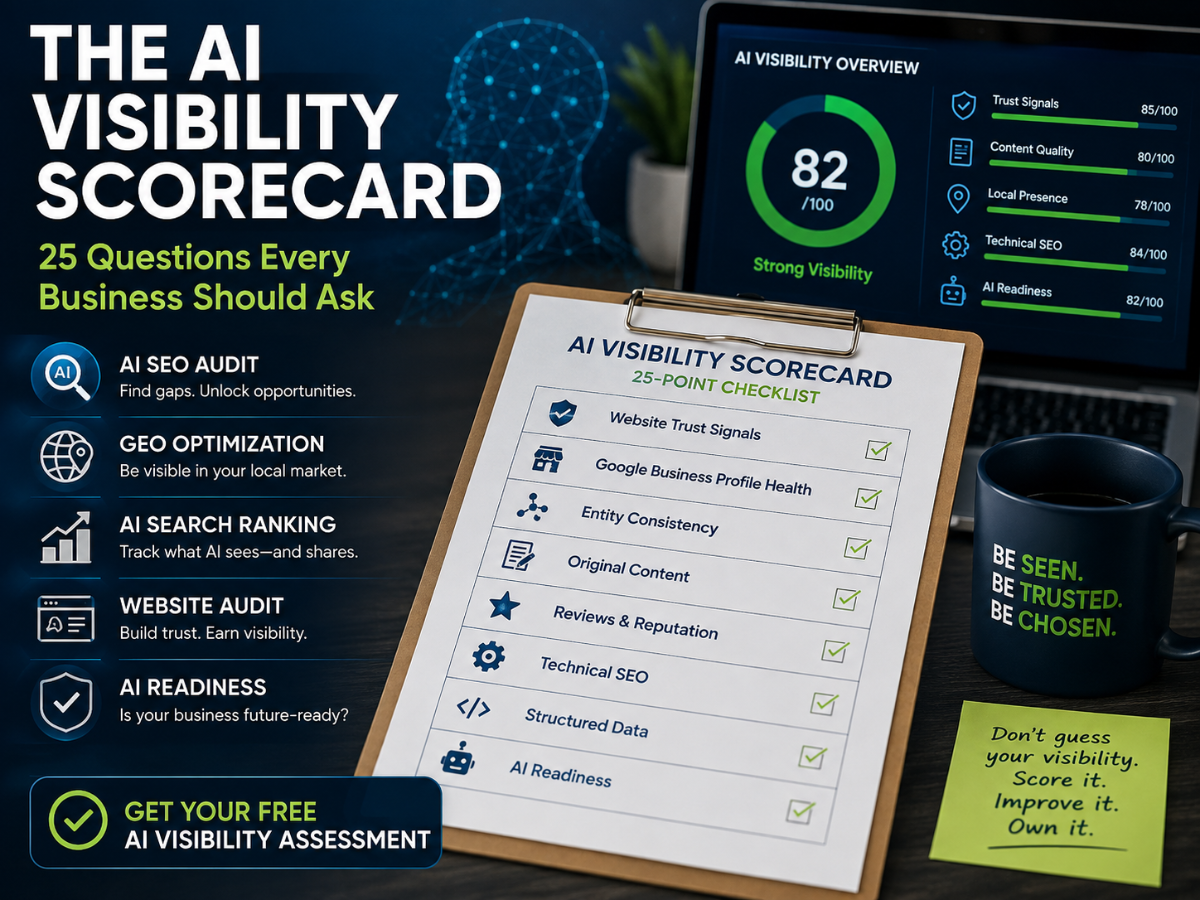
At Relentless Business Mastery, we specialize in building complete local SEO ecosystems for small businesses in Reno and across the United States. If you're not sure where your current strategy has gaps, a Local SEO and AI Visibility Audit is the fastest way to find out.
Book your free Local SEO and AI Visibility Audit today; we'll review your website, GBP, citations, reviews, and AI visibility, then walk you through a clear, prioritized plan to grow.
Frequently Asked Questions About Local SEO Strategy
What is a local SEO ecosystem?
A local SEO ecosystem is the interconnected set of digital assets and signals, including your website, Google Business Profile, online reviews, local citations, Google Maps presence, and AI search visibility, that collectively determine how prominently your business appears in local search results. Optimizing these elements together produces compounding results that isolated tactics cannot achieve.
How long does it take for local SEO to show results?
Most businesses see measurable improvements in Google Business Profile performance and local citation accuracy within 30 to 60 days. Significant improvements in Maps rankings and organic traffic typically emerge within 3 to 6 months, depending on market competitiveness and how comprehensively the strategy is implemented.
What is the difference between Google Maps SEO and local SEO?
Local SEO is the broader strategy that improves your visibility across all local search results, including organic listings, AI Overviews, and directory platforms. Google Maps SEO is a subset of local SEO focused specifically on improving your ranking within Google Maps and the Map Pack that appears in Google Search results.
What is Generative Engine Optimization (GEO) for local businesses?
Generative Engine Optimization (GEO) is the process of structuring your website content, business information, and online presence so that AI-powered search tools, including Google AI Overviews, ChatGPT, and Gemini, can accurately understand and recommend your business. GEO for local businesses involves schema markup, FAQ content, consistent entity information, and high-quality review signals.
How many reviews does a local business need to rank well?
There is no single threshold, as the required volume depends on your market and industry. What matters most is a combination of volume, recency, and quality. A business with 50 recent, detailed, well-responded-to reviews will typically outperform a competitor with 200 older reviews that have gone unmanaged.
What is Search Box Optimization and how does it help local businesses?
Search Box Optimization (SBO) is a strategy designed to get your business or service to appear as an autocomplete suggestion in Google's search bar. When users see your business suggested before they finish typing, it captures high-intent traffic earlier in the search process, often converting at a higher rate than standard organic clicks.
How do local citations affect AI search recommendations?
AI systems like Google's AI Overviews and ChatGPT use citation data, mentions of your business name, address, and phone number across directories and online platforms- as one signal of your business's legitimacy and prominence. Consistent, accurate citations across authoritative directories increase the likelihood that AI tools will reference your business in response to relevant local queries.
Have any more questions?
Recent Posts