Search Box Optimization
(SBO) is the practice of influencing Google Autocomplete suggestions so your business appears before users ever reach the search results page. By targeting specific keyword phrases in the autocomplete dropdown, local businesses can bypass competitors, build brand authority, and capture high-intent customers at the earliest stage of their search journey.
Most local businesses pour their marketing budgets into Google Ads and traditional SEO, fighting for position on a results page that users may never even reach. There's a smarter entry point, and very few businesses are using it.
Search Box Optimization
places your brand name directly in the search box as a suggested query before a user finishes typing. The result? Your business becomes the search term itself. No bidding wars. No competing ads. Just your brand, front and center, the moment a potential customer starts looking.
This guide breaks down exactly how SBO works, why it's such a powerful complement to local SEO, and what steps you can take to start owning search suggestions in your market.
Search Box Optimization, also called Autocomplete Optimization, is the process of influencing search engine autocomplete suggestions to feature your brand or a branded keyword phrase. When someone begins typing a query into Google, Bing, or YouTube, the search engine instantly generates a dropdown list of predicted searches. SBO targets that dropdown.
Rather than waiting for users to scroll past paid ads and organic results to find your business, SBO positions your brand as the suggestion itself. A user typing "best HVAC company in Denver" might see your business name populate before they finish the phrase. One click on that suggestion, and they land directly on your website, bypassing every competitor on the results page.
This isn't just a visibility play. It's a full-funnel advantage. SBO captures users at the moment of intent, before they've considered alternatives.
How Google Autocomplete Influences Buying Behavior
Google Autocomplete suggestions aren't random. Google's algorithm generates them based on real search data, what users are actually typing, how often, and how recently. Suggestions carry implicit credibility. Users tend to perceive autocomplete results as trusted, relevant recommendations rather than ads.
This psychological advantage is significant. Research consistently shows that most clicks go to the first few results a user sees. When your brand name appears as a search suggestion, it benefits from that same "top of list" bias, except you're appearing before the results page even loads.
The downstream effects on buying behavior include:
- Higher click-through rates: Autocomplete clicks tend to convert at a higher rate because users who select a suggestion have already expressed strong intent.
- Lower competition at the click point: Unlike a search results page crowded with paid ads and organic listings, an autocomplete selection often leads to a branded search where your business dominates the entire first page.
- Increased perceived authority: Being a suggested search term signals to users that your brand is well-known and widely searched, even if that perception is being actively cultivated through SBO.
For local businesses especially, this early-stage visibility can dramatically shift how potential customers evaluate their options.
How SBO Builds Brand Authority Signals
Brand authority in local SEO is built on one core concept: people searching for you by name. When Google sees a consistent volume of branded searches, users typing your business name directly, it interprets that as a trust signal. SBO accelerates this process.
Every time a user clicks on your business name in the autocomplete dropdown, they generate a branded search. Over time, these accumulate and reinforce your brand's authority in Google's eyes. The results compound: more branded searches lead to stronger entity recognition, which leads to better organic rankings, which leads to even more brand searches.
This is why SBO isn't just a traffic tactic; it's a long-term brand-building strategy. Businesses that invest in autocomplete optimization are essentially training Google to associate their names with specific search queries, thereby deepening their footprint in local search results.
For local service businesses, law firms, medical practices, home services, and real estate agencies, this kind of brand reinforcement can be the difference between ranking in the Google Local Pack and being invisible.
Entity Search and Why It Matters for SBO
Modern SEO has shifted from keyword-matching to entity recognition. Google no longer just looks at the words on your page; it tries to understand who you are, what you do, and how you relate to other entities in your market.
An "entity" in SEO terms is a clearly defined, distinguishable concept, a business, a person, a place, or a product. The more clearly Google can identify your business as a recognized entity with a specific role in your local market, the more confidently it will surface you in relevant searches.
SBO contributes directly to entity development. When your branded keyword phrase appears repeatedly in autocomplete, gets clicked, and leads to engaged sessions on your website, Google strengthens its understanding of who you are and what you offer. Pair this with consistent NAP (Name, Address, Phone) data across directories, a well-optimized Google Business Profile, and structured data markup on your website, and you build an entity profile that search engines and AI systems can recognize and cite with confidence.
This matters even more as AI-powered search tools like Google's AI Overviews and ChatGPT become primary research tools for local buyers.
SBO is underused, but it's also frequently misunderstood. Here are the most common mistakes that prevent businesses from getting results:
Targeting overly generic terms. Choosing broad keywords like "lawyer" or "plumber near me" without geographic or service specificity makes it harder to influence autocomplete suggestions and dilutes the impact. Precise, locally anchored phrases work far better.
Ignoring brand consistency. If your business name appears differently across your website, Google Business Profile, and other directories, Google struggles to connect the dots. Entity consistency is non-negotiable.
Skipping the measurement phase. Many businesses treat SBO as a set-and-forget tactic. Without tracking branded search volume, click behavior, and autocomplete appearance, you can't optimize the campaign or prove ROI.
Expecting instant results. Autocomplete suggestions take time to influence. Businesses typically begin to see their brand name appear in autocomplete results within 45–60 days of a well-executed SBO campaign. Patience and consistency are required.
Treating SBO in isolation. SBO works best when integrated with a broader local SEO strategy. Without a strong website, an optimized Google Business Profile, and quality content, the clicks generated by autocomplete won't convert.
How to Measure the Success of an SBO Campaign
Measuring SBO results requires looking beyond traditional SEO metrics. Here's what to track:
Branded search volume. Use Google Search Console to monitor how often users are searching for your brand name. A growing trend in branded impressions and clicks is one of the clearest indicators that SBO is working.
Autocomplete appearance frequency. Manually search for your target keyword phrases regularly across different devices and locations to confirm your brand appears in autocomplete suggestions.
Click-through rate on branded terms. If your brand is showing in autocomplete and your branded CTR is climbing, users are responding.
Cost-per-click comparison. One of SBO's core advantages over paid search is cost efficiency. Autocomplete clicks can cost 5–10 times less than equivalent PPC clicks in competitive categories. Tracking this comparison demonstrates clear financial ROI.
Organic ranking improvements. As branded search volume grows and user engagement increases, watch for improvements in your organic rankings for both local and non-branded terms, a sign that Google's entity recognition of your business is strengthening.
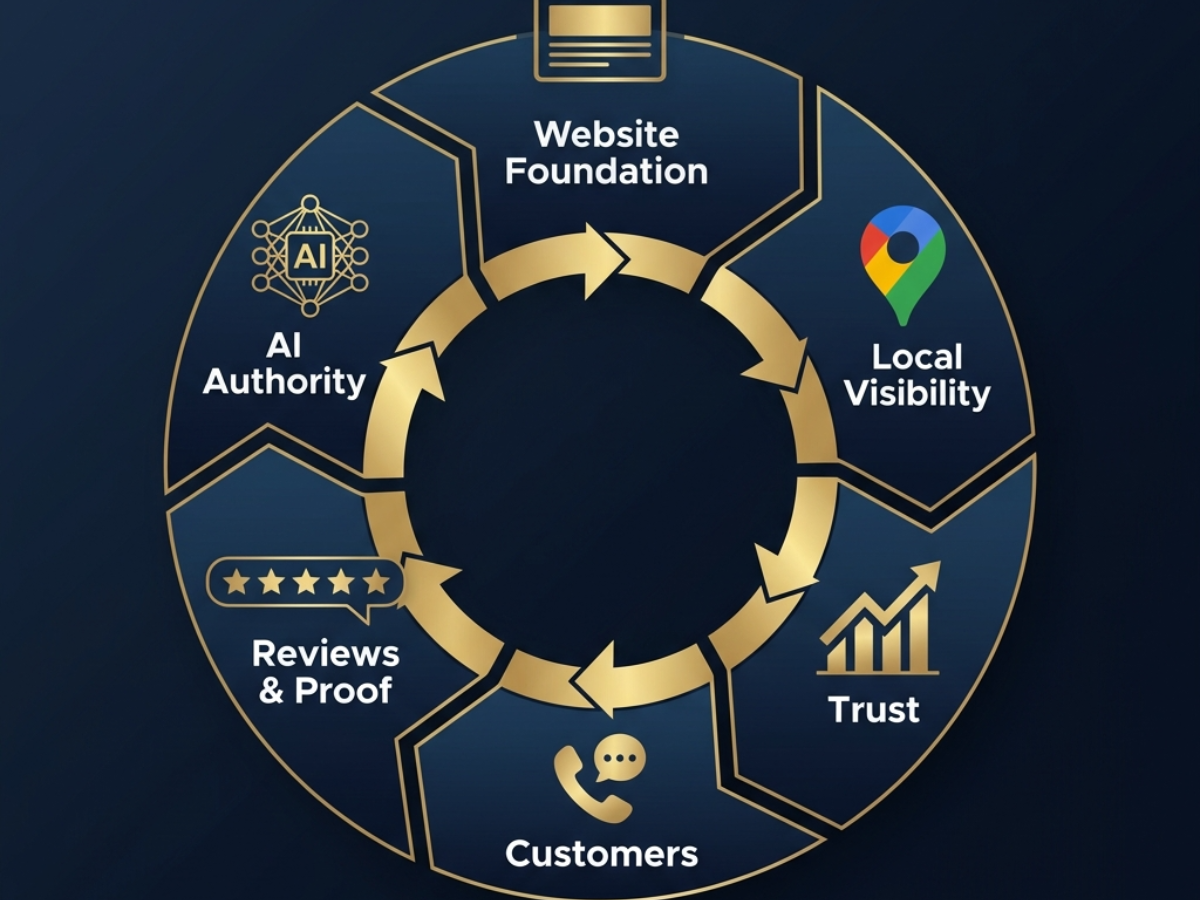
SBO doesn't replace local SEO; it supercharges it. Here's how the two work together:
Google Business Profile optimization. A fully optimized GBP profile reinforces your entity in Google's knowledge graph. When SBO drives branded searches, a strong GBP ensures users find accurate, compelling information immediately.
Local landing pages. Autocomplete clicks often lead to your homepage or a specific landing page. Make sure those pages are locally optimized with clear service areas, location-specific content, and strong calls to action.
Review generation. High review volume and positive ratings improve your Local Pack rankings and validate your brand to users who discover you through autocomplete.
Content marketing. Publishing locally relevant, authoritative content strengthens your entity relationships and provides additional pages for Google to associate with your branded terms.
Structured data markup. Schema markup helps Google understand your business's services, location, and relationships to other entities, compounding the authority signals built through SBO.
When all these elements work in concert, the result is a local search presence that's genuinely difficult for competitors to displace.
Google's EEAT framework, Experience, Expertise, Authoritativeness, and Trustworthiness, has become central to how it evaluates content and businesses. SBO aligns with EEAT in ways that most agencies overlook.
When your brand appears as a recognized autocomplete suggestion, it signals authoritativeness. When users consistently choose your suggestion and engage with your content, it signals trustworthiness and expertise. When that activity generates branded searches over time, your business becomes an increasingly credible entity in Google's understanding of your local market.
Few agencies have the methodology or the experience to leverage SBO as part of an EEAT strategy. That's precisely why businesses that invest in it now gain a durable competitive edge.
For local businesses looking to own their market online, Search Box Optimization isn't a bonus tactic; it's a foundational advantage.
Start Owning Your Search Terms Before Your Competitors Do
Search Box Optimization sits at the intersection of brand strategy, local SEO, and user psychology. Get it right, and your business becomes the first thing potential customers see the moment they start searching, not a result they stumble upon after wading through ads and competitors.
The window to own specific autocomplete keyword phrases in your market is open, but it won't stay that way. Search terms claimed through SBO are exclusive; once a competitor locks in a phrase, it's no longer available to you.
If you're ready to capture buyers before they even reach the results page, we'd love to show you how our SBO program works.
Book a free demo today and find out which search terms are available in your market.