The AI Visibility Scorecard: 25 Questions Every Business Should Ask
Quick answer: AI visibility measures how well AI-powered search tools, like ChatGPT, Google AI Overviews, and Gemini, can find, understand, and recommend your business. Businesses that score well consistently demonstrate expertise, publish original content, maintain accurate business information, and provide verifiable customer outcomes. Use this 25-question scorecard to assess your current standing.
Most business owners have already done the hard part. They built a website. They set up a Google Business Profile. They may have even invested in SEO at some point. But search has changed, and the rules that determined visibility yesterday are no longer enough.
AI-powered search tools now answer questions directly. They summarize options. They recommend businesses by name. And here's the problem: if your business isn't structured in a way that AI systems can understand and trust, you won't be mentioned, regardless of how good your product or service actually is.
That's what AI visibility is. It's the degree to which AI-powered search tools can accurately understand, trust, and confidently recommend your business when a potential customer asks.
This scorecard gives you 25 diagnostic questions organized across six critical categories. Work through each one honestly. By the end, you'll know exactly where your business stands, and where the gaps are costing you customers.
What Is AI Visibility, and Why Does It Matter for Your Business?
Traditional SEO focused on getting your website to rank on Google's first page. That's still important. But something significant has shifted.
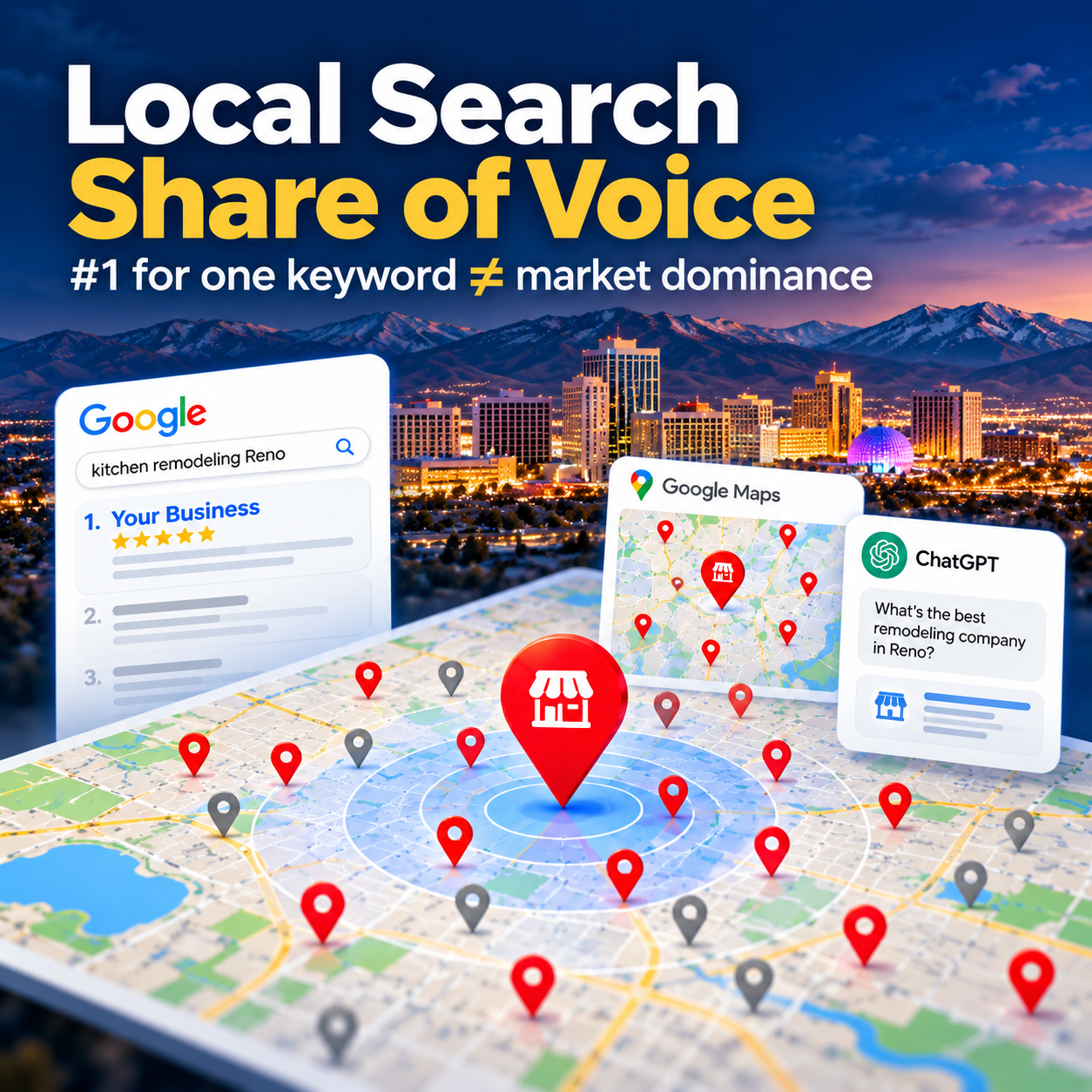
Customers increasingly ask AI tools- ChatGPT, Google AI Overviews, Gemini, Perplexity, Copilot- for recommendations rather than scrolling through a list of blue links. When someone types "best HVAC contractor near me" into a standard search, they get ten results. When they ask an AI assistant the same question, they may get three names, or one.
That's a dramatically smaller window of opportunity.
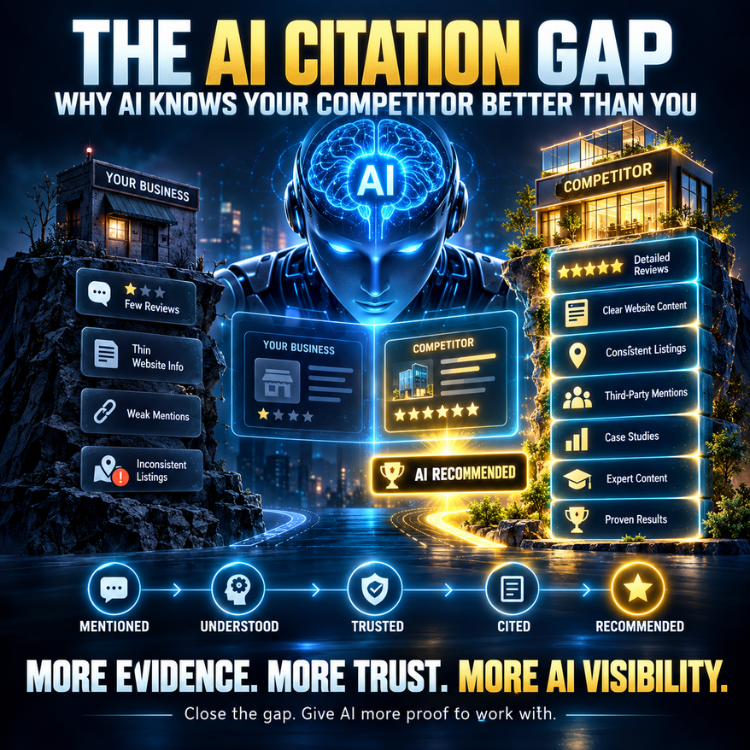
Businesses that get recommended by AI systems tend to share common traits: they demonstrate clear expertise, they publish original content that answers real questions, their business information is accurate and consistent everywhere online, and they have verifiable customer outcomes in the form of reviews and case studies.
AI visibility isn't a replacement for traditional local SEO. It's an extension of it, and for businesses that want to capture the next wave of customer demand, it's no longer optional.
Section 1: Website Trust Signals (Questions 1–5)
AI systems evaluate credibility before recommending a business. Your website is the foundation. If it doesn't communicate trust clearly and quickly, AI tools will choose a competitor that does.
1. Does your website clearly state what you do, who you serve, and where you operate, within the first few seconds of landing on it?
If a visitor (or an AI system) has to read several paragraphs to understand your business, that's a problem. Clarity is credibility.
2. Do you have a dedicated "About" page that explains your background, experience, credentials, and team?
AI systems look for entities they can understand and verify. A well-written About page gives them the context they need.
3. Does your website include verifiable proof of results, case studies, before-and-after examples, or documented client outcomes?
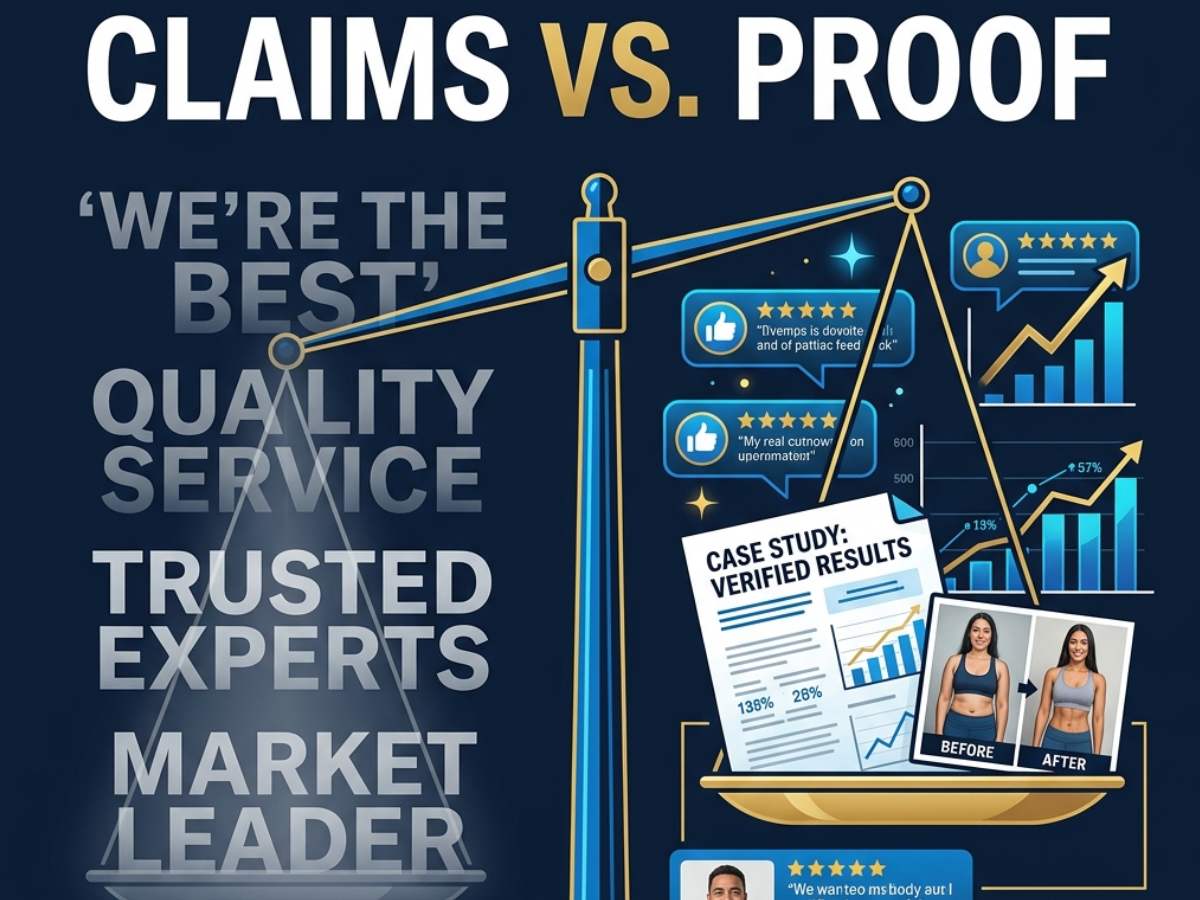
General claims like "we get results" carry far less weight than specific, verifiable outcomes.
4. Is your contact information (name, address, phone number) clearly displayed on your website, and does it match what's published elsewhere online?
Inconsistent contact information is a trust signal failure. It tells both search engines and AI systems that your business information may be unreliable.
5. Does your website load quickly and function correctly on mobile devices?
Page speed and mobile performance directly affect how search engines and AI crawlers index and evaluate your content.
Score yourself: Each "yes" earns one point. A score of 3 or below in this section signals significant risk to your AI visibility.
Section 2: Google Business Profile Health (Questions 6–10)
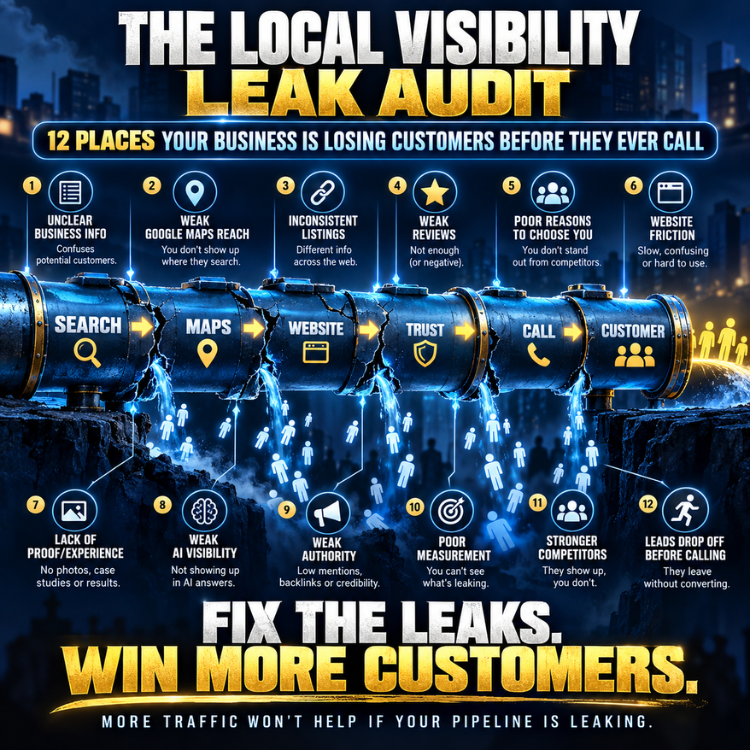
Your Google Business Profile is one of the primary data sources AI systems use to understand and recommend local businesses. An incomplete or outdated profile is one of the most common, and fixable, visibility gaps.
6. Is your Google Business Profile fully completed, including business category, description, services, hours, and service areas?
7. Have you uploaded recent, high-quality photos of your business, team, work, or products within the last 90 days?
8. Are your hours consistently accurate, including holiday hours and any temporary changes?
9. Do you post updates, offers, or announcements to your Google Business Profile at least twice per month?
10. Have you responded to every review, both positive and negative, within the past six months?
Review responses signal active management. AI systems treat an engaged, well-maintained profile as a stronger trust signal than a dormant one.
Score yourself: A score of 2 or below here is a direct threat to your local AI search ranking.
Section 3: Entity Consistency (Questions 11–13)
"Entity consistency" refers to whether your business information is accurate and uniform across every platform where it appears. This matters because AI systems cross-reference multiple data sources. Conflicting information creates confusion, and confused AI systems don't recommend businesses they can't confidently verify.
11. Is your business name, address, and phone number identical across your website, Google Business Profile, Yelp, Facebook, Apple Maps, and any industry directories?
Even minor inconsistencies, such as a suite number listed on one platform but not another, can reduce your AI visibility score.
12. Is your business listed in relevant industry-specific directories and local citation sources?
13. Does your business appear in any third-party data sources that AI tools commonly reference, such as BBB, Chamber of Commerce listings, or local news coverage?
Third-party mentions from credible sources strengthen your entity in the eyes of both traditional search engines and AI systems.
Score yourself: All three should be a "yes." Any gap here is worth addressing before moving to more advanced optimization strategies.
Section 4: Original Content and Expertise (Questions 14–18)
AI-powered search tools are designed to surface the most trustworthy, expert-level information available. Businesses that publish original, helpful, experience-backed content are far more likely to be recognized and recommended.
14. Does your website include a blog, resource center, or FAQ section that answers common questions your customers actually ask?
15. Is the content on your website written from genuine experience, or does it read like generic, template-style copy that could apply to any business in your industry?
16. Have you published content in the last 60 days?
Freshness matters. Stale websites signal stagnant businesses to AI systems.
17. Does your content include specific details, named locations, measurable outcomes, real examples, rather than vague, general statements?
Content that says "We helped a Reno contractor increase qualified leads by 80% in 90 days" is far more useful to an AI system, and a potential customer, than "We help businesses grow."
18. Do you have any content that directly answers questions your customers ask AI tools, such as "What's the best [service] company in [city]?" or "How do I choose a [service provider]?"
Conversational, question-answering content is the backbone of strong AI visibility.
Score yourself: A score of 2 or below in this section suggests your content strategy needs significant attention before AI search optimization can take hold.
Section 5: Reviews and Reputation (Questions 19–21)
AI systems treat reviews as social proof and authority signals. The volume, recency, and sentiment of your reviews directly affect whether AI tools recommend your business over a competitor.
19. Do you have at least 25 Google reviews, with the majority rated 4 stars or above?
20. Have you received at least three new reviews within the past 30 days?
Review velocity, how frequently new reviews arrive, tells AI systems that your business is actively serving customers right now, not just six months ago.
21. Do your reviews include specific details about the services you provide, the outcomes customers experienced, and the location where you serve them?
Keyword-rich, outcome-focused reviews carry significantly more weight than generic "great service!" testimonials.
Score yourself: Reviews are one of the fastest-moving levers in your AI visibility strategy. If you scored 1 or below here, a review generation system should be your next immediate priority.
Section 6: Technical SEO and Structured Data (Questions 22–25)
This final section addresses the technical infrastructure that helps both search engines and AI systems accurately interpret and categorize your content.
22. Does your website use schema markup (structured data) to clearly identify your business type, location, services, reviews, and contact information?
Schema markup is essentially a translation layer. It tells search engines and AI systems exactly what your content means, not just what it says.
23. Is your website free of broken links, duplicate content, and crawl errors?
Technical errors create friction for AI crawlers. A technically clean website is easier to index, categorize, and recommend.
24. Does your website include clear internal linking that connects relevant pages, such as linking your service pages to related blog posts or FAQs?
25. Is your website secured with HTTPS, and does it meet current Core Web Vitals standards for loading speed, interactivity, and visual stability?
Security and performance aren't optional. They're baseline requirements for trust in AI-indexed environments.
Score yourself: A score of 2 or below in this section means your technical foundation may be limiting the impact of every other optimization you make.
How to Interpret Your AI Visibility Score
Add up your total score across all 25 questions.
- 20–25: Strong AI visibility foundation. Focus on refinement, content freshness, and emerging AI search optimization strategies.
- 13–19: Moderate visibility. Significant gaps exist that are likely costing you customer inquiries. Prioritize the sections where you scored lowest.
- 7–12: Weak AI visibility. Competitors with stronger signals are capturing the customers already searching for your services.
- 0–6: Critical gaps. Your business is largely invisible to AI-powered search tools and may be underperforming in traditional local search as well.
Businesses that score well on AI visibility consistently demonstrate expertise, publish original content, maintain accurate business information, and provide verifiable customer outcomes. The good news: every gap identified by this scorecard is fixable with the right strategy.
What Should You Do With Your Score?
A score tells you where you stand. A strategy tells you how to move.
Some gaps, like inconsistent business listings or an incomplete Google Business Profile, can be corrected quickly. Others, like building a library of high-quality, experience-backed content or earning a consistent flow of keyword-rich reviews, require a sustained, systematic approach.
The scorecard is the diagnosis. What comes next is the plan.
Download the printable AI Visibility Scorecard to walk through these 25 questions with your team, mark your current status on each item, and identify which categories to prioritize first. Once you've completed it, you'll have a clear picture of where your business stands, and a roadmap for where to focus.
Ready to find out exactly what's holding your business back from AI search visibility? Request your free complete AI and Marketing Visibility Assessment from Relentless Business Mastery. We'll review your website, Google Business Profile, entity consistency, content strategy, reviews, and technical foundation, and deliver a clear, prioritized growth plan with no obligation.
Get Your Free AI Visibility Assessment →
Frequently Asked Questions About AI Visibility
What is AI visibility, and how is it different from traditional SEO?
AI visibility refers to how well AI-powered search tools, such as ChatGPT, Google AI Overviews, Gemini, and Perplexity, can understand, trust, and recommend your business. Traditional SEO focuses on ranking in Google's organic search results. AI visibility extends that goal to include how AI systems discover and surface your business when users ask conversational questions. The two strategies overlap significantly, but AI visibility also requires structured content, entity consistency, and verifiable expertise signals that standard SEO alone doesn't always address.
How can I measure my AI readiness as a small business?
The 25-question scorecard in this post is a practical starting point. Evaluate your website trust signals, Google Business Profile completeness, entity consistency across directories, content quality and freshness, review volume and recency, and technical SEO health. Each "yes" answer represents a strength. Each "no" is a gap. Businesses with the highest AI readiness scores tend to have consistent, accurate information everywhere online and publish specific, experience-based content that AI systems can extract and cite.
Does AI visibility affect Google rankings?
Yes; indirectly but meaningfully. Many of the signals that improve AI visibility also strengthen traditional Google rankings. These include high-quality content, accurate and consistent business information, strong review signals, technical website health, and structured data. Optimizing for AI visibility is not a separate strategy from SEO. Relentless Business Mastery treats AI search optimization (GEO) as an evolution of local SEO, not a replacement for it.
Can small businesses compete with national brands in AI search results?
Yes; particularly in local search. AI-powered tools increasingly prioritize local relevance when users ask location-specific questions. A small business with a well-optimized Google Business Profile, strong local reviews, consistent citations, and original content demonstrating real local expertise can outperform a national brand with limited local presence. Local specificity is a competitive advantage, not a disadvantage.
How often should I update my AI SEO audit?
Conduct a full AI SEO audit at minimum every quarter. AI search environments evolve quickly; what worked six months ago may no longer be sufficient. More importantly, your business information, service offerings, and competitive landscape change over time. Treat your AI visibility scorecard as a living document, not a one-time exercise.
Recent Posts